
The Conversation Is the New Search: ChatGPT Ads in Southeast Asia
Last Updated: Nov 20, 2026
Southeast Asia stopped searching. It started asking.
For twenty years, the most valuable moment in digital marketing was a search box. A person typed a few words, a results page appeared, and brands paid to be on it. That moment is moving. Across Indonesia, Malaysia, the Philippines, Singapore, Thailand and Vietnam, consumers now open ChatGPT and ask a whole question: which air purifier suits a KL condo, how to plan five days in Hokkaido with two kids, whether a credit card’s travel insurance is worth the fee.
Until September 2026, brands had no way to be present in that conversation. Now they do. ChatGPT Ads went live across six Southeast Asian markets on 23 September 2026, and Intrepid has added it to its digital media offering as a managed performance channel.
This paper explains what ChatGPT Ads are, why the region is unusually well placed to benefit, and the three capabilities that make it a performance channel rather than a brand experiment: Smart Prompt ads, conversion tracking, and product catalog integration.

Advertising at the moment of decision
A ChatGPT Ad is a sponsored card that appears beneath an answer when the conversation signals a relevant product or service. It is labelled “Sponsored”, kept visually separate from the answer, and OpenAI commits that ads never shape the answer itself. Ads are shown only to logged-in adults on the Free and Go plans; Plus, Pro, Business, Enterprise and Edu users never see them.
The matching logic is the real change. There are no keywords to buy. Advertisers describe the situations their product fits, which OpenAI calls context hints, and the phrases they want to stay away from. The platform reads the whole conversation, not a two-word query, and decides whether the brand belongs there. Advertisers receive aggregated performance data only; no conversation content is ever shared.
Four commitments underpin the format, and they matter to brand teams as much as to users:
- Answer independence. Ads do not influence what ChatGPT says.
- Conversation privacy. Conversations stay private from advertisers, and user data is never sold.
- User control. People can turn off personalisation, dismiss any ad, and see why it was shown.
- Protected spaces. No ads for under-18 accounts, and none near health, mental health or political topics.
“The brief has changed. We are no longer writing a headline for a results page. We are writing the next helpful line in someone’s conversation.”
Why Southeast Asia is the proving ground
ChatGPT Ads run on the Free and Go tiers, and those tiers are where the overwhelming majority of Southeast Asian users sit. In subscription-heavy markets, a large share of the audience is ad-free. In this region, the addressable audience is close to the whole user base. Reach is, proportionally, stronger here than almost anywhere the product has launched.Three more reasons the region leads:
- High Intent unavailable elsewhere. A user asking “which budget air purifier is best for a residential condo in KL” has told the platform more than any search query. The click arrives pre-qualified.
- An auction that is still quiet. Self-serve access is weeks old in SEA and gated by category approval. Brands that move in Q4 2026 buy against few competitors and build conversion history before prices rise. Early US benchmarks sit around USD 3 to 5 per click; SEA minimum budgets are set far lower, so local pricing should settle well below US levels.
- Own-website outcomes. Every ad lands on the brand’s own site, and every conversion is measured there. For brands that have grown on Shopee, Lazada and TikTok Shop, this is a direct route to first-party traffic and first-party data.
Three capabilities that make it a performance channel
Plenty of new media is interesting. Very little of it is accountable. ChatGPT Ads arrives with the three things a performance marketer needs on day one.
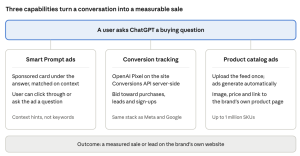
ChatGPT Ads capability stack · 3 pillars
A buying question enters at the top; each pillar carries it one step closer to a sale the brand can count.
1. Smart Prompt ads
The Smart Prompt ad is the conversational unit: a sponsored card beneath the answer that the user can click through or expand and question inside the chat, so the ad answers the buyer’s follow-up before the click. It carries the advertiser name, logo, headline, description, one image and a landing-page link.
What changes for creative teams is the brief. Nobody writes a keyword list. The brand describes 10 to 20 buying situations in plain language (“a family comparing travel insurance for a Japan trip”), three headline and description variants for each, and the phrases to stay away from. The copy reads as the natural next line in a conversation, not a search headline.
Best fit: considered purchases with comparison questions (insurance, telco, credit cards, property, electronics, beauty), travel and hospitality planning, local-service lead generation, and direct-to-consumer retail through the product feed.
2. Conversion tracking
ChatGPT Ads are measured on a brand’s own website the way Meta, Google and TikTok are: a browser pixel, a server-side Conversions API, and conversion-optimised bidding that learns from those signals. OpenAI launched the Pixel and Conversions API in May 2026 to capture “a purchase, lead, sign-up, or other meaningful action”, and added conversion optimisation in August.
|
Layer |
What it gives the brand |
|---|---|
|
OpenAI Pixel |
Browser tag that records page views and conversions after a click; deployed through the existing tag manager
|
|
Conversions API |
Server-side events that survive browser tracking limits and feed conversion bidding; works with Hightouch, Tealium and LiveRamp
|
|
Campaign objectives |
Reach, Clicks or Conversions, with the conversion event chosen per campaign
|
|
Reporting |
Impressions, clicks, CTR, CPC, CPM, conversions and device split in Ads Manager
|
|
Third-party attribution |
AppsFlyer, Adjust, Branch, Kochava, Triple Whale, Northbeam and others for app and multi-touch views
|
Brands receive aggregated, non-identifying data only and never see conversation content. There is no search-term report; optimisation works through context hints and negative phrases. The model is privacy-neutral for the advertiser: no customer data leaves the brand except hashed first-party lists for custom audiences, the same mechanism as Meta Custom Audiences, keeping campaigns inside PDPA, Indonesia’s PDP Law and the Philippines’ DPA.
3. Product catalog integration
Product-feed campaigns let a retailer upload its catalogue once and have ChatGPT generate ads automatically for the products that match a conversation, the same way Google Shopping and Meta Advantage+ catalog ads work. The campaign type launched in May 2026 and supports catalogues of up to one million SKUs.
Brands already running Google Merchant Center or Meta Commerce Manager feeds can reuse the same source. ChatGPT reads product attributes as natural language, so a title written the way a shopper would say it (“lightweight running shoe for humid weather, wide fit”) outperforms a SKU string. When a conversation matches, the ad shows the product’s image, price and a link to the brand’s own product page, and the Pixel records the purchase so bidding can optimise toward sales value.
For Southeast Asian retail, this is the headline benefit: catalogue traffic on the brand’s own domain instead of a marketplace listing, no new creative production, and scale across thousands of SKUs with one weekly feed refresh.
A new stage in the funnel, not a new name for an old one
The question every CMO asks is whether this replaces something. It does not. Meta and TikTok create demand. Google Search captures it once the user knows what to type. ChatGPT Ads sits between the two, where the shortlist is still being formed and a single helpful suggestion can decide it.
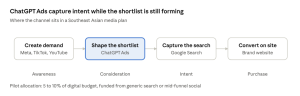
Where ChatGPT Ads sits in the funnel · 4 stages
Demand flows left to right; ChatGPT Ads is the stage where consideration becomes intent, before a search query exists.
What it means for brands in the region
The common thread is a new source of intent for the brand’s own website, at a time when search costs in Southeast Asia keep rising and marketplace fees keep eating margin. The way in differs by sector.
|
Business Types |
What ChatGPT Ads provides |
Where to start |
|---|---|---|
|
Brands with search and social media buys |
High-intent traffic that search cannot reach, at early-mover prices |
Smart Ads with Clicks, then Conversions, using the tags and landing pages we already have |
|
E-commerce and D2C retailers |
Catalog with own website as landing page instead of a marketplace listing |
Product-feed campaigns using existing Merchant Center feed, with Pixel and Conversions API for purchase value |
|
Travel, finance, telco and property |
Presence in the comparison conversation where the decision is made |
Smart Prompt ads with context hints per product line and a lead event through the Conversions API |
|
Brands new to performance media |
A low-risk entry: labelled, brand-safe, no minimum commitment |
A small always-on budget on the Reach objective with negative phrases and brand-suitability settings |
Two honest caveats. The channel is weeks old in the region: pricing benchmarks are still forming, attribution partners have not yet confirmed Southeast Asian coverage, and visual and video formats are still in US testing. And categories near health, mental health and politics are excluded by design. For most consumer brands, neither changes the case. They change the pace: start measured, learn fast, and scale on evidence.
Intrepid’s point of view
In the near future, AI conversations will be an essential part of the performance marketing, along-side traditional search, social media and programmatic media. We aim to integrate it with our current full-funnel marketing services and available across SEA markets.
How we bring it to market:
- Measurement setup. Every new Ad Account gets the OpenAI Pixel and Conversions API implemented into the brand’s existing tag and server-side layer, reconciled against website analytics, so the first dollar spent is a dollar learned from.
- Conversational briefs. Our teams use context hints and negative phrases by vertical and by market, so the ad reads like the next helpful line, not an interruption.
- Feed-first retail. Brands with a Merchant Center or Commerce Manager feed can activate ChatGPT ads with product-feed campaigns.
- Pilot, prove, scale. A recommended eight-week pilot with weekly learnings and an incrementality measurement at the end, measured against paid search CPA and catalog-ad ROAS, before any always-on commitment.
- One plan, every channel. ChatGPT Ads sits inside the same media plan, dashboard and optimisation rhythm as search and social, so it is judged on the same numbers.
The moment is open. For now.
Every major channel has had a window when the audience was there, the auction was quiet and the brands that showed up early set the benchmarks everyone else chased. Search had it. Social had it. In Southeast Asia, conversational AI has it right now.
If your customers are asking ChatGPT which product to choose, the only question left is whether your brand is mentioned in the answer.
Talk to Intrepid experts about a ChatGPT Ads pilot: intrepid.asia.